The foundational text
Why this plane is the lowest rung, why we are the demons on it, and why the whole arrangement is coursework rather than punishment.
Read the foundational text
usteria holds that this plane is a school, not a courtroom, and that changes what morality actually is here. It is not a list of rules handed down by a distant judge, waiting to catch us breaking them. It is closer to the mechanics of the place itself: how weight gets added to a soul, and how weight gets taken off.
What we call conscience may simply be the part of us still able to hear the curriculum.
Every tradition this project draws from eventually arrives at some version of the same discovery, that how we treat each other is not a side issue next to the "real" spiritual work. It is the spiritual work, showing up in the only laboratory any of us actually has, which is an ordinary day.
Start with the strangest fact about morality across religions: how little disagreement there actually is at the center of it. Christianity gives the command to love your neighbor as yourself. Judaism's Hillel, asked to summarize the whole of Torah while standing on one foot, is said to have answered that what is hateful to you, do not do to another, and that everything else is commentary. Islam holds, in a well known hadith, that none of you truly believes until you want for your brother what you want for yourself.
Confucian teaching states the same principle in its negative form, do not impose on others what you yourself do not want. Buddhism teaches that a state that is not pleasing or delightful to me cannot be so to another, and that I cannot inflict that state on another. Hindu texts describe this as the essence of dharma in a single line: do not do to others what would cause you pain if done to you.
Seven traditions, none of them copying from the others, none of them needing to. That kind of agreement, arrived at independently and repeated for thousands of years, is not decoration. It is closer to a survey result. Something about morality is built into the actual structure of what a soul is, not just into the culture it happened to grow up in.
On film The Golden Rule

If there is a floor under all of this, most traditions place it at the same spot: do not harm. Jain teaching builds an entire discipline around ahimsa, non-violence extended so far that some monastics sweep the ground ahead of their own feet. Hindu and Buddhist ethics carry the same word and the same weight. Sikh teaching names the impulses that lead to harm directly, the five thieves at the door of the mind, and treats guarding against them as daily work rather than a one-time vow.
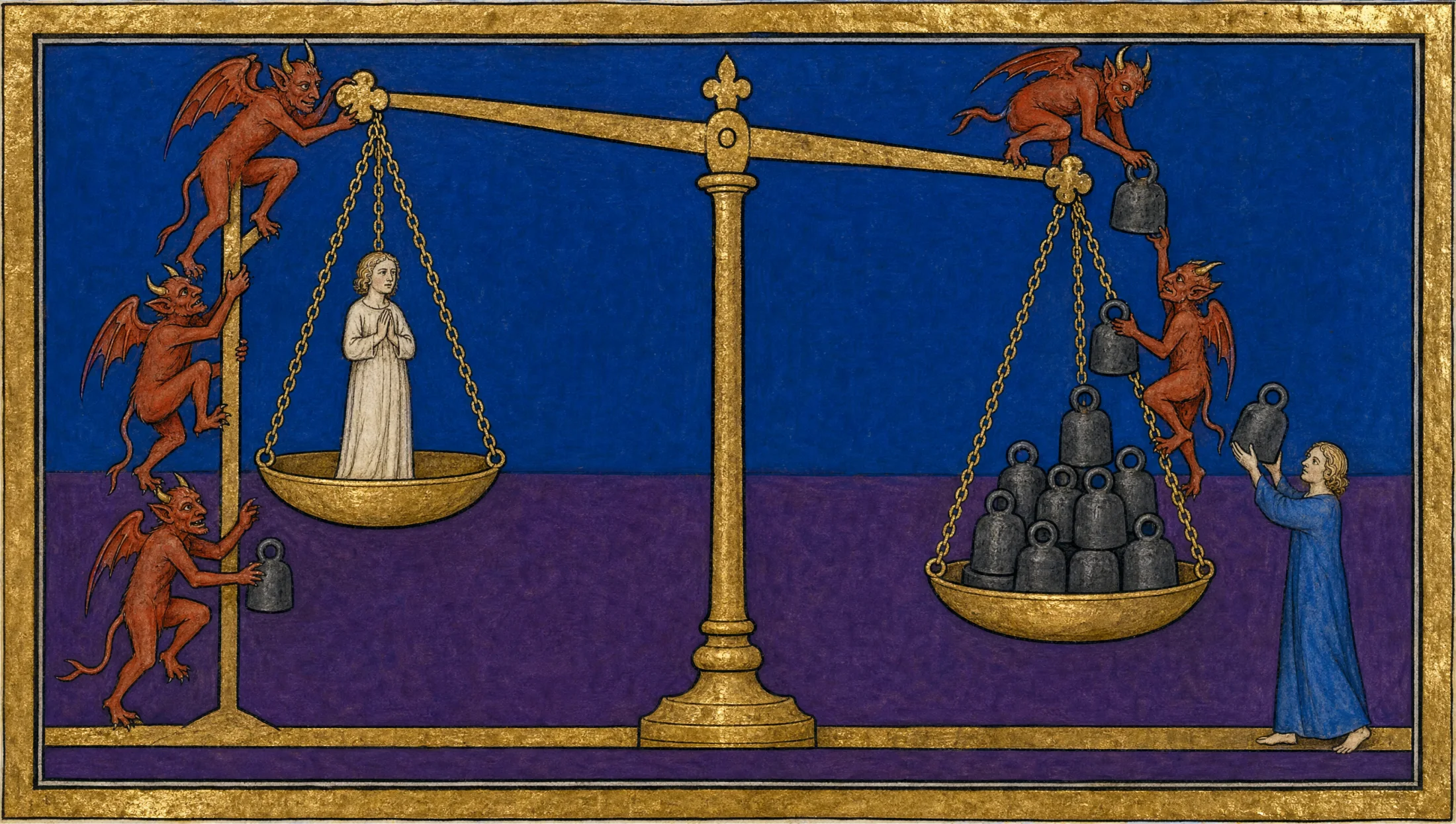
Harm is not just the obvious kind, a fist or a blade. Every tradition here also names the quieter versions: the lie that costs someone their footing, the contempt that never gets spoken aloud but shapes how a person is treated anyway, the indifference that lets suffering continue because addressing it would be inconvenient. Musteria holds that each of these, large or small, is what actually deepens the fog on this plane. Not because a scorekeeper is tallying it somewhere. Because harm is the mechanism by which the lower forces described in the foundational text get their grip.
Every unnecessary cruelty is a vote for staying asleep.
On film Jainism
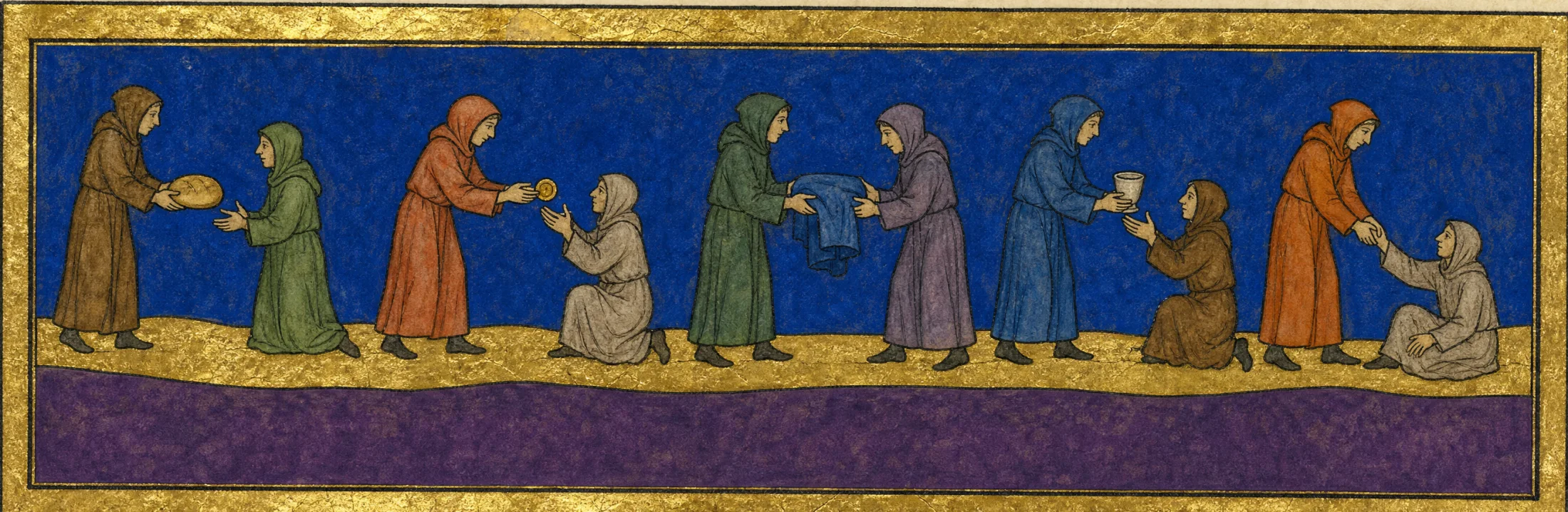
Almost as universal as the prohibition on harm is a corresponding instruction to give. Judaism calls it tzedakah, a word that shares its root with justice rather than charity, as though giving to someone in need were less a kindness than a debt finally being paid. Islam builds zakat, obligatory almsgiving, directly into its core practice, not an optional virtue but a pillar. Buddhism calls it dana, generosity, considered the first of the perfections a person develops on the path, the one everything else is built on top of. Sikh teaching calls it vand chakko, sharing what you have, paired with kirat karo, earning it honestly in the first place.
What is striking is how many of these traditions frame generosity as correction rather than generosity in the modern, optional sense. The assumption underneath tzedakah and zakat alike is that what you hold was never entirely yours to begin with, held instead in trust, on behalf of people who have less of it.
Giving, in this frame, does not make a person good. It simply stops making them a thief of time they were only ever borrowing.
Zoroastrianism names truth and its opposite directly: asha, the order and honesty the universe is built from, set against druj, the lie that corrodes it. Every honest word is treated as a small act of asha. Every deception, however minor, is treated as a small act of druj, feeding the same force that keeps this whole plane clouded. Hindu ethics names the same virtue satya, truthfulness, listed among the foundational disciplines a soul practices before anything more advanced becomes possible.
Musteria takes this literally rather than as metaphor. A lie is not just socially costly. It is a small refusal to let reality be what it is, and reality being what it is happens to be the entire curriculum.
A person who tells the truth, even when it costs them something, is practicing the same skill the whole plane is supposedly here to teach: seeing clearly, and refusing to look away.
On film Zoroastrianism
Every tradition here eventually warns against a subtler failure than open cruelty, which is doing the right thing for the wrong reason. The Bhagavad Gita's teaching on karma yoga instructs a person to act rightly without attachment to the fruit of the action, doing good because it is good, not because of what it will earn. Islamic ethics places enormous weight on niyyah, intention, holding that an identical act can be worship or vanity depending entirely on what sat behind it. Jesus warns against giving alms to be seen doing it, saying the reward for that kind of giving has already been paid out in full, in attention, with nothing left over.
This matters because Musteria is not selling good behavior as a transaction, karma points banked toward a better next life. That framing just relocates the same self-interest the traditions are all warning against.
The actual work is quieter: noticing when the motive underneath a kind act is really about how it will look, and choosing the kindness anyway, for its own sake, until the difference between the two starts to close.
On film Hinduism Christianity Islam
Put together, the traditions Musteria draws from are not handing down a rulebook so much as describing a single, repeated exercise: notice the harm before you cause it, give more than feels comfortable, tell the truth even when it costs you, and do the good thing without needing anyone, including yourself, to be watching.
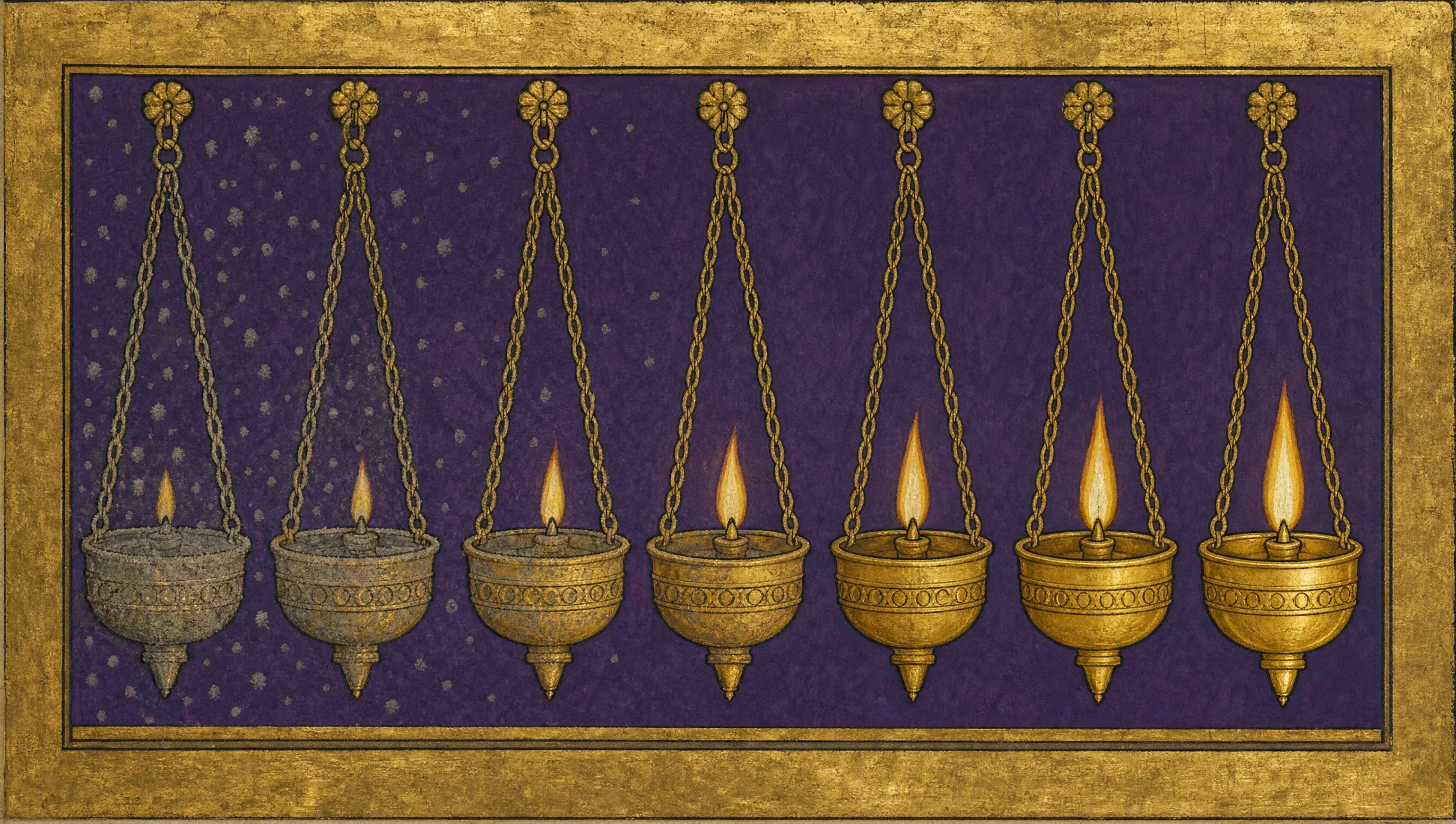
None of this earns escape from this plane in the way a ticket earns passage. It is the plane, worked correctly. A soul that keeps choosing this way is not accumulating credit. It is simply becoming lighter, the same way a lamp gets brighter once the dust stops settling on the glass.
This is the part of the school that never requires a classroom. It is available in every ordinary exchange, all day, to anyone paying attention.
On film Taoism Gnosticism Indigenous & shamanic
Why this plane is the lowest rung, why we are the demons on it, and why the whole arrangement is coursework rather than punishment.
Read the foundational textThree things, and they can all be started tonight. Naming the floor, noticing the pull, and taking the hardest moment of the day as coursework.
Begin the first practiceA season for each of these traditions on the work of doing good, taking at length what the margins of this leaf can only name.
Watch the series